Alarm Standards
Process alarms are used to draw the operator’s attention to an abnormal condition that, if disregarded, could lead to poor product quality, unplanned downtime, damaged assets, personnel injury or a catastrophic accident. Alarm management is one of many layers of protection to prevent the escalation of a hazard into an accident.
Standards
In 2009, the standard ANSI/ISA-18.2, “Management of Alarm Systems for the Process Industries” (ISA-18.2) was released. It provides guidance that helps users design, implement and maintain an alarm system in order to optimize performance for an operator response to alarm. ISA-18.2 was used as the starting point for the creation of an international standard, IEC 62682, which was released in 2014. The ISA-18.2 standard is considered a recommended and generally accepted good engineering practice (RAGAGEP) by insurance and regulatory agencies.
Most process industry plants are driven to create additional productivity/efficiency and extend the life of their assets. One of the easiest and most effective ways to do this is to address a poorly performing alarm system and its effect on operator performance.
What is an Alarm?
According to the standards, an alarm is defined as an audible and/or visible means of indicating to the operator an equipment malfunction, process deviation, or abnormal condition that requires a response. When employed appropriately, alarms help the operator to keep the plant running safely and within normal operating conditions. If alarms instead serve as a distraction or nuisance, then the performance of the operator suffers.
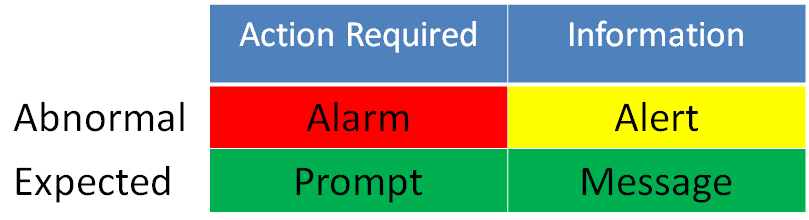 |
A message like “mixer running normally” should not be classified as an alarm because it is information and requires no action from the operator. Message other than alarms distract the operator.
Basic vs Advanced Reporting
XLReporter provides alarm reporting in two ways Standard and Advanced.
Standard Alarm Reporting
Standard reporting is available with every edition of XLReporter that supports database connectors. With this, XLReporter queries the database where alarms are being logged by the provider to return a filtered list of alarms over a period of time. Basic metrics like total alarm counts, alarm counts by tag, average number of alarms over each day of a month can be derived.
Advanced Alarm Reporting
Advanced reporting is available with the Advanced Alarm Management module which is available with the Ultimate edition of XLReporter. This module measures all the metrics suggested by the ISA-18.2 and IEC62682 standard and provides the necessary information that will help identify systematic design issues and specific areas for improvement. This document describes the Advanced Alarm Management module.
Alarm Hierarchy
XLReporter considers the alarm hierarchy discussed below. Not every alarm system supports this hierarchy and thus, configuration options are available to adhere to this convention.
In the hierarchy, alarms are generated from modules (tags) which have attributes (e.g., HIHI). The modules belong to Areas (locations in the facility) which are managed from Operator Positions. Collectively this is all part of a Facility. The hierarchy is depicted in the following diagram.
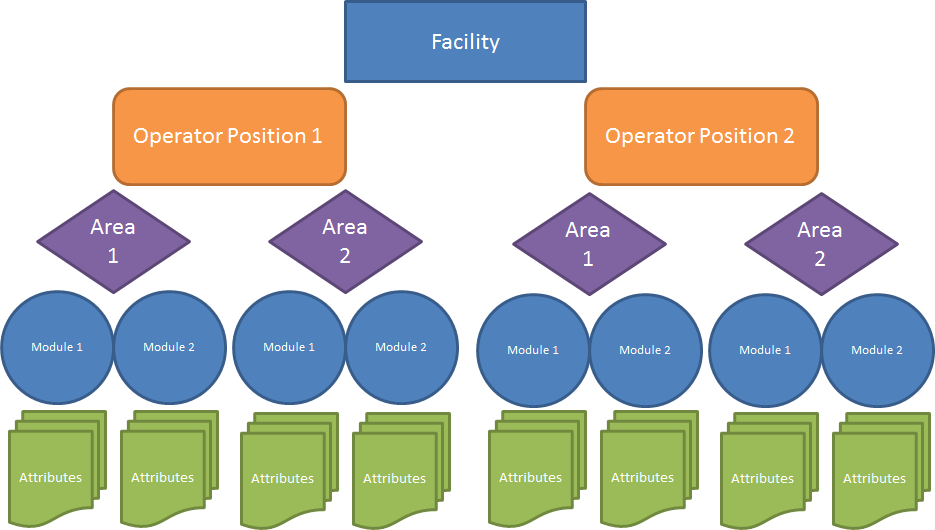 |
Alarm Cycle
Alarms are typically in one of the following states:
Active-Unacknowledged
This signifies the occurrence of a new alarm (start of cycle). The alarm is active and has not been acknowledged by the operator.
Active-Acknowledged
This signifies that the alarm is active and is acknowledged by an operator.
Inactive-Unacknowledged
This signifies that the alarm is not active and has not been acknowledged by the operator.
Inactive-Acknowledged
This signifies the end of the alarm cycle. The alarm is inactive and has been acknowledged by the operator.
Other irregular states such as Disabled and Suppressed are also possible.
To determine the metrics, each of these states have to be identifiable in the alarm system. Alarm systems from different vendors have different methods of determining these states. XLReporter provides settings for the alarm states as part of the Connector definition (see later).