Reasons
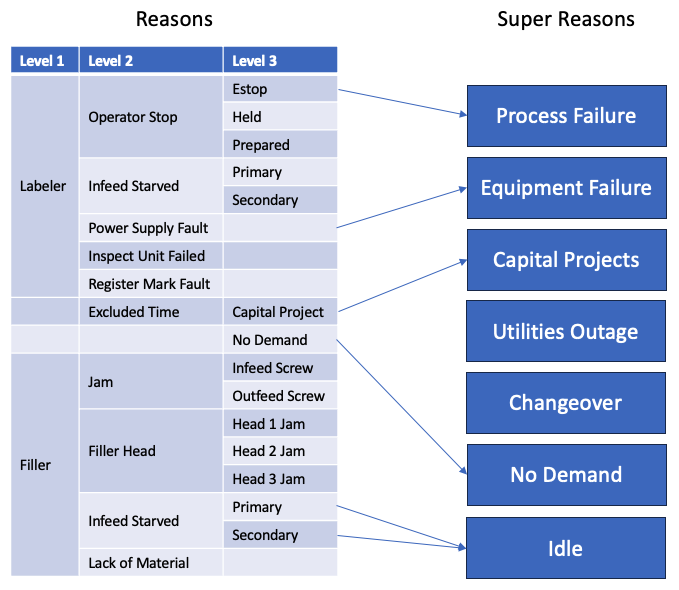
Each asset is assigned a single reason list, which contains a hierarchical reason structure. When an asset changes state, a reason is assigned to this new event, by virtue of a numeric OPC code.
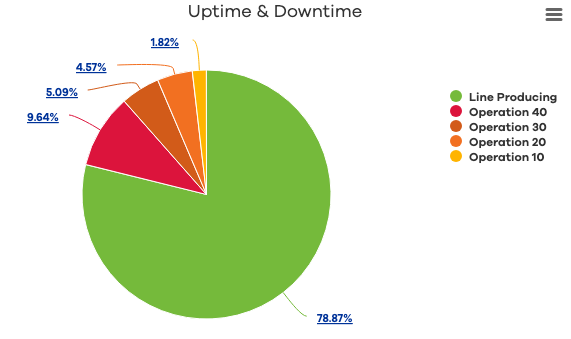
When evaluating downtime, a pie chart allows summarization at each reason level. Drilling into a reason at level 1 will then yield a summary of all its constituent level 2 reasons, and so on.
A reason is a complex element, therefore, and has several attributes assigned in configuration when creating a new reason.
Reason Attributes
A Reason is one of the components of an Event. It consists of a hierarchical assignment in asset's reason list, as well as an OPC code assignment and a "super reason" to represent one of your organization's downtime loss buckets.
Attribute | Description | Example |
|---|---|---|
opccode | An integer, unique within a reason list, used to represent the reason combination | 8905 |
reasonlevel1 | A string, typically 20 characters or fewer, representing the top level reason. This is usually the name of the unit op to which this reason applies | Filler |
reasonlevel2 | Another string, typically representing a component of the unit op, or a fault name | Infeed Screw |
reasonlevel3 | A further qualification of the reason, if necessary | Drive Motor Overload |
reasonlevel4 | A further qualification of the reason, if necessary (often unused) | |
superreason | A string representing the organization's loss bucket into which this reason combination falls | Process Failure |