


The New Paradigm of Industrial Enterprise Integration
A quiet revolution has been unfolding across the industrial world. And the shift is clear: we’ve moved beyond the old paradigm and into a new, more powerful model for industrial integration.
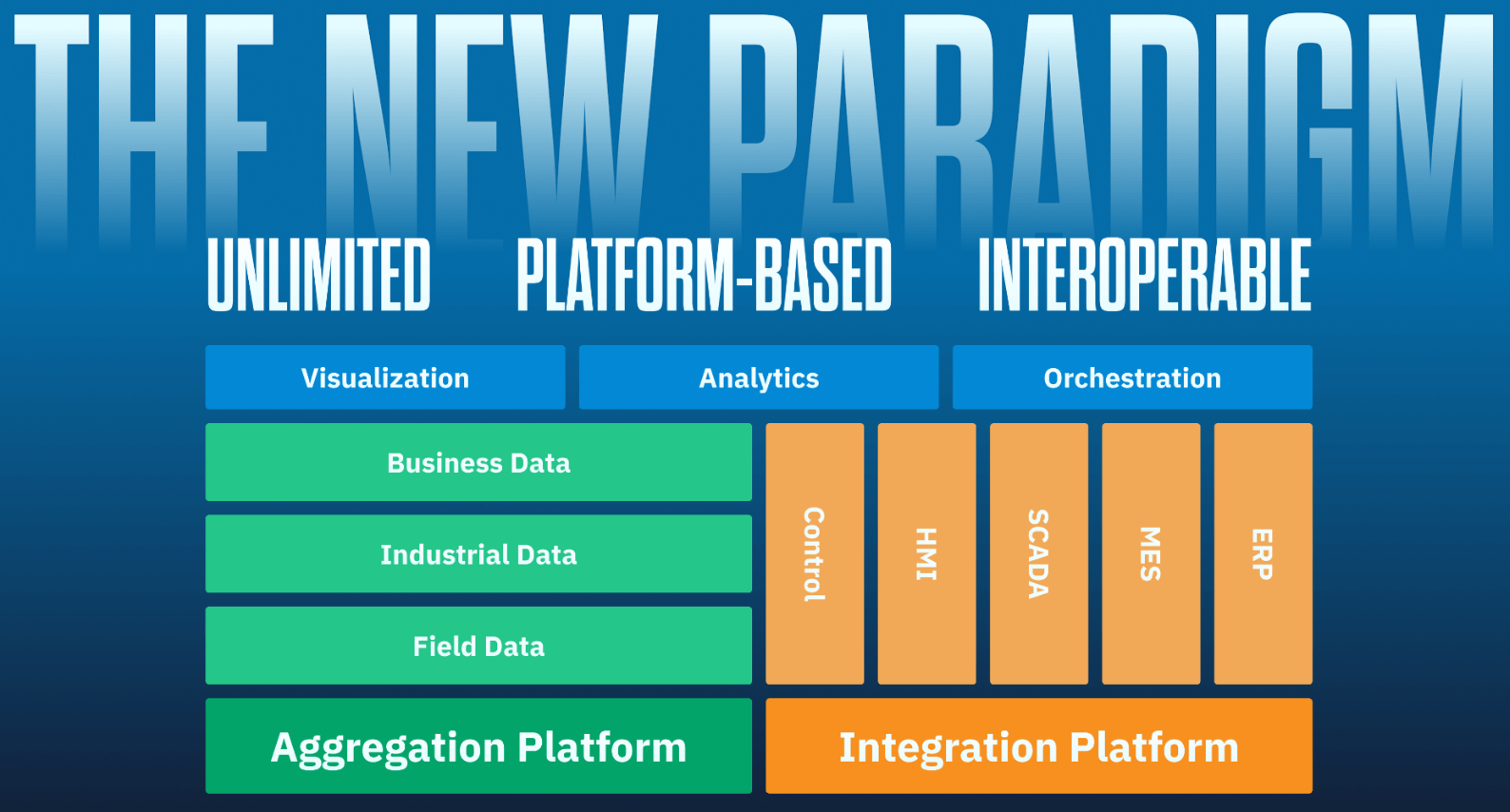
A quiet revolution has been unfolding across the industrial world. For years, manufacturers, integrators, and industrial enterprises have been pushing toward a simple goal: not just to optimize each layer of their operations, but to operate beyond layers entirely. They’ve needed visibility, control, and coordination across systems that span the whole organization—from the plant floor to the enterprise and everywhere in between.
And the shift is clear: we’ve moved beyond the old paradigm and into a new, more powerful model for industrial integration.
How the Old Paradigm Took Shape, and Where It Fell Apart
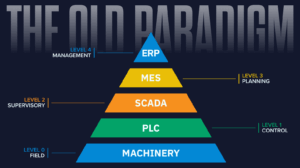
For decades, we were taught to think of industrial architecture as a series of neat, rigid layers: sensors and PLCs on the bottom, SCADA and MES in the middle, ERP on top. Integration only happened between layers, and each tier was managed by its own specialized tools, technologies, and teams.
It looked clean. It looked logical.
But it was a mirage.
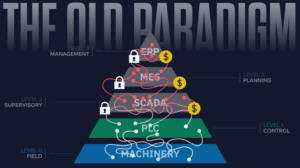
In the real world, most systems weren’t aligned with that pyramid at all. Instead, enterprises ended up with siloed software, inconsistent data models, and a growing collection of fragile, custom-designed integrations that were expensive to build and nearly impossible to maintain. The result was a patchwork of protocols, workarounds, and quick fixes, never the cohesive architecture the pyramid promised.
This model didn’t break all at once. It eroded over time.
As IT technologies advanced rapidly and the variety of devices, data sources, and applications exploded, the old point-to-point integration model simply couldn’t keep up. Legacy industrial software, built on proprietary technologies and designed around strict licensing limits, forced companies deeper into silos and deeper into vendor lock-in. OT tools focused only on their layer of the pyramid, not on the broader enterprise need for seamless data movement.
By design, these tools put constraints on the very people they were supposed to empower—charging for tags, clients, designers, and every little increment of growth. They slowed enterprises down at precisely the moment they needed to speed up.
The pyramid-based model collapsed not because it was wrong for its time, but because the world around it evolved. Modern industrial operations demanded speed, scale, openness, and interoperability—none of which the old paradigm could deliver.
And that collapse created space for a new paradigm to emerge.
The Birth of the New Paradigm
The new paradigm of industrial enterprise integration starts with a simple mandate:
Liberate your data.
You must be able to access it from anywhere, organize it, use it, and share it—without limitations, artificial constraints, or restrictive licensing. This openness requires an unlimited mindset, backed by solutions designed for unlimited scalability.
The second pillar of the new paradigm is the need for a platform. Not a patchwork of disconnected products, but a unified, coherent foundation that spans traditional layers. If you’re going to operate beyond the pyramid, you need technology built to transcend it natively.
A major milestone in this shift came in 2013, when Germany’s Industrie 4.0 Working Group published a pivotal paper outlining the future of industrial systems. They predicted two critical components:
- An Integration Platform that spanned the traditional automation pyramid—linking PLCs, SCADA, MES, ERP, and more into a common operational backbone.
- An Aggregation Platform that existed outside the layers—a unified environment for collecting, contextualizing, and orchestrating data across plants, processes, or even entire organizations.
This vision may have been theoretical when published, but over the last decade, it has become reality.
True IT/OT convergence is not about one vendor solving everything. The world is too big, industries too diverse, and use cases far too varied. Instead, the new paradigm is built on openness, interoperability, and extensibility, the key traits required for a world where data must flow freely across systems.
IIoT and MQTT: The Moment Everything Changed
Another breakthrough came in 2015, when MQTT—an open, lightweight messaging protocol dating back to the late 1990s invented by Arlen Nipper and Dr. Andy Standford-Clark—re-emerged in industry and quickly became a major force in shaping modern architectures. As the Industrial Internet of Things (IIoT) took hold, MQTT provided a fast, efficient, decoupled communication method for pushing data from the edge to anywhere in the enterprise.
MQTT and IIoT opened the door to a new pattern of integration by allowing edge devices to publish data directly into a shared infrastructure, accessible by any application. This change naturally led to the concept of the Unified Namespace (UNS): a single, organized, real-time data layer where all systems publish and consume information. In short, UNS removes silos by giving the entire enterprise a common, live source of truth.
What was IIoT, really, but an end-run around the pyramid? And what is a UNS but a direct challenge to data silos?
By enabling edge devices to publish data directly into a common, accessible data infrastructure—available to any application, at any layer—MQTT effectively realized the aggregation platform envisioned in the early Industrie 4.0 framework.
It transformed industrial integration from a chain of brittle connections into a flexible, scalable, event-driven architecture.
Ignition and the Rise of the Platform Era
Ignition by Inductive Automation played a pivotal role in shaping the new paradigm. Ignition exemplified the core concepts that Industry 4.0 required from the start:
- Unlimited licensing to empower growth and remove artificial constraints
- A unified, modular, platform-based architecture to integrate and visualize data across systems
- Built-in openness and interoperability, enabling seamless connectivity with any device, database, or application
- A scalable foundation for both the Integration Platform and the Aggregation Platform
By combining Ignition with MQTT, enterprises finally achieved the three core tenets of Industry 4.0:
- Vertical integration of systems across the entire manufacturing stack
- End-to-end integration across design, engineering, and operations
- Horizontal integration across plants, partners, and the broader value chain
These weren’t abstract goals—they became real, operational, production-ready capabilities.
And when you add modern cloud technologies, Kubernetes-based orchestration, rapid infrastructure automation, and a wave of advancement across both IT and OT, you get a fundamental shift.
Not an evolution.
A new paradigm.
Where We Stand Now
After ten years of pioneering work by innovators and early adopters, this new paradigm is no longer emerging, it’s mainstream. Companies of every size are now figuring out how to begin their journey, deepen their implementation, or push new boundaries on top of foundational platforms.
IT and OT haven’t blurred together. They remain distinct disciplines, each with its own expertise and purpose. But the wall between them is gone. Instead, they’re now connected by shared infrastructure, shared data, shared tools, and shared opportunity.
And that collaboration has unleashed a wave of creativity, innovation, and new products unlike anything the industry has seen before.
Travis Cox – Chief Technology Evangelist
Travis Cox started with Inductive Automation in 2004 and previously served in leadership roles in various divisions including Co-Director of Sales Engineering. In his current role as Chief Technology Evangelist, Travis builds relationships with industrial professionals to foster innovation and raise awareness of industry trends, modern technologies, open standards, and the many possibilities of the Ignition platform. Travis shares the company’s vision far and wide to increase the growth and reach of the global Ignition community. He shares his message through a variety of formats, including presenting at conferences and events, meetings with customers and industry leaders, and media interviews.